
AR & VR Solutions by TECHCOM: Transforming Industry and Education
In an era where technology evolves at breakneck speed, the boundaries between the physical and digital worlds are blurring. At TECHCOM, we are at the forefront of this revolution, specializing in integrating Augmented Reality (AR) and Virtual Reality (VR) to solve complex industrial, educational, and marketing challenges. From our headquarters in Indianapolis, we provide world-class technical services that empower organizations—from the US Military to global automotive leaders—to visualize the impossible. This comprehensive guide explores how TECHCOM leverages AR and VR to redefine engine maintenance, technical training, and interactive marketing, providing a roadmap for businesses ready to embrace the future of visualization.
1. Understanding the AR & VR Landscape: Overlay vs. Immersion
Before diving into the applications, it is crucial to understand the distinction between these two powerhouse technologies. While often grouped, they serve distinct purposes in a professional environment.
Augmented Reality (AR): The Best of Both Worlds
Augmented Reality overlays digital information—such as 3D models, annotations, and animations—onto the real-world environment. Using devices like tablets, smartphones, or AR glasses, users can see the physical world around them enhanced by computer-generated content.
- Key Advantage: It enables hands-on interaction with physical equipment while providing digital guidance.
- Application: Ideal for on-the-job training and real-time maintenance.
Virtual Reality (VR): Complete Digital Immersion
Virtual Reality creates a fully immersive, 100% computer-generated environment. When a user puts on a VR headset, they are “transported” to a digital world where they can practice procedures without physical hardware.
- Key Advantage: It excels at simulating high-risk or high-cost scenarios in a safe, controlled setting.
- Application: Perfect for simulating complex failure scenarios or exploring physically inaccessible environments.
2. Revolutionizing Engine Maintenance and Industrial Training
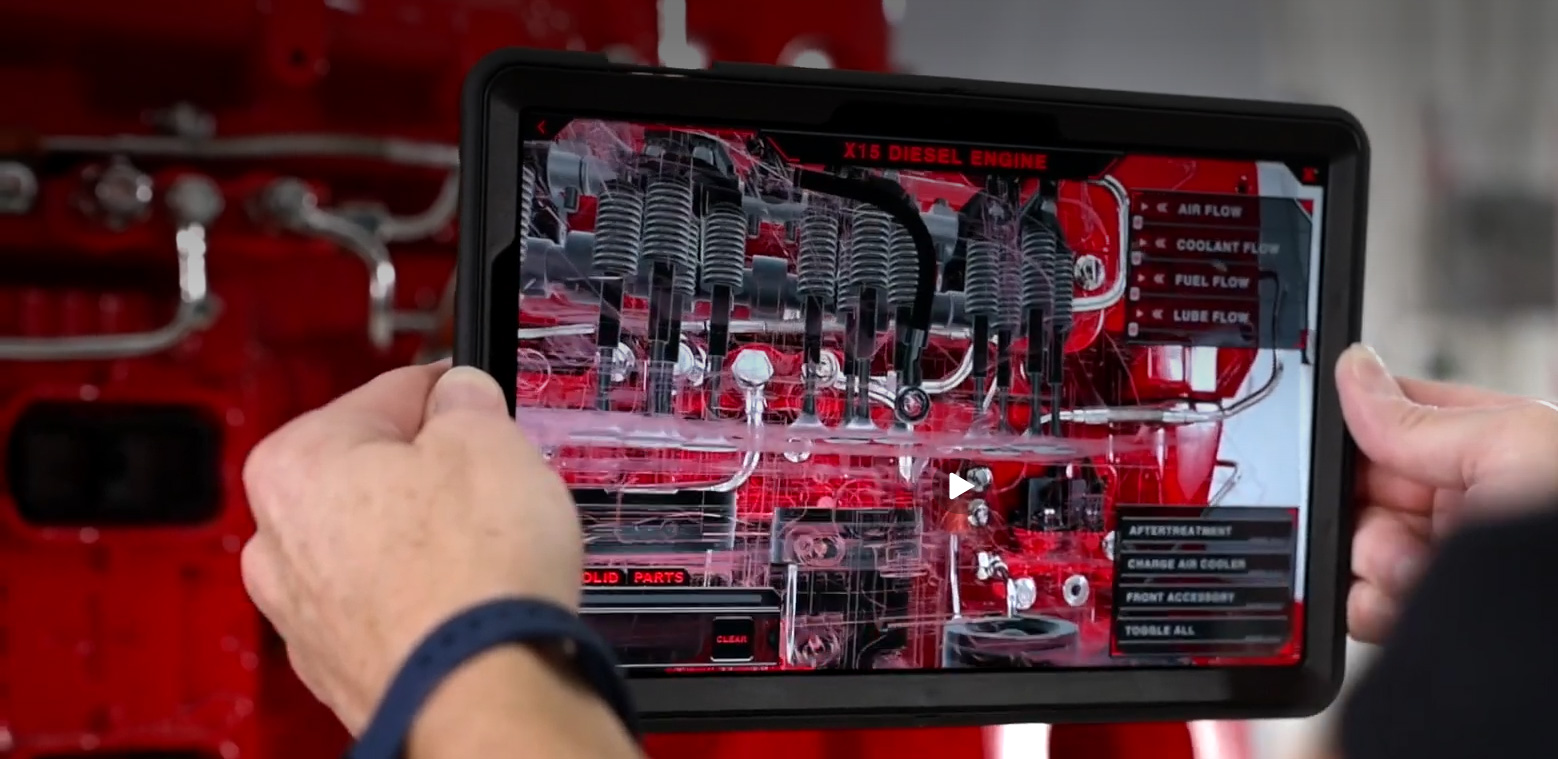
One of the most impactful applications of AR at TECHCOM is in engine maintenance and training. Engines are incredibly intricate systems with internal mechanisms that are often hidden from view—AR strips away these barriers.
Real-Time Visualization and Overlays
Technicians can point an AR-enabled device at a physical engine and see a “digital twin” overlaid directly onto the hardware. This provides:
- X-Ray Vision: The ability to see “through” the engine casing to view internal fluid flows, gear rotations, and electrical pathways.
- Step-by-Step Guidance: Digital arrows and annotations guide the technician through a repair process, highlighting exactly which bolt to turn or which wire to check.
- Real-Time Data Integration: Superimposing live data like temperature, pressure, and fluid flow rates onto the display for dynamic performance monitoring.
Enhancing Efficiency and Safety
By utilizing AR for training, industries can significantly reduce the risks associated with hands-on learning on actual, expensive engines. Mistakes made in a virtual or augmented environment are non-destructive and highly cost-effective.
- Reduced Downtime: Technicians can complete repairs faster with digital checklists and expert guidance at their fingertips.
- Error Minimization: Animations for complex procedures ensure that even novice mechanics can follow intricate maintenance schedules with high precision.
- Remote Support: AR allows remote experts to see what the technician sees on-site, providing guided instructions from anywhere in the world.
3. The Techcom Advantage: Beyond the Screen
What sets TECHCOM apart is our ability to combine digital innovation with physical expertise. Our Vehicle Cutaways are world-renowned, and when paired with AR, they become the ultimate educational tool.
Interactive Cutaway Displays
We don’t just stop at a physical model. By adding an AR layer to our Cutaway Engine Displays, we create an interactive experience:
- Zoom and Manipulate: Users can zoom in on specific parts of a cutaway or trigger animations to see how components interact.
- Customizable Learning: Our AR displays can adapt to the user’s knowledge level—offering basic terminology for beginners and deep technical specs for experts.
- Multimedia Integration: We integrate videos, technical diagrams, and 3D Printing models to provide a holistic view of the product.
4. Industry-Specific Applications of AR & VR
Government and Defense
TECHCOM understands the rigorous standards of military training. AR is used for jet engine maintenance training (as seen with the US Air Force), enabling recruits to learn more quickly and reduce critical errors in high-pressure environments.
Automotive and Logistics
Global leaders like Boeing, Bosch, and DHL are already reaping the benefits of AR:
- Electrical Wiring: Boeing uses AR to overlay 3D images onto physical aircraft components for complex wiring training.
- Logistics Efficiency: DHL employs AR to assist in the “picking” process in warehouses, providing visual cues that speed up operations.
- Dealership Training: Automotive workshops use AR to visualize digital wiring diagrams on physical vehicles, reducing diagnostic time by up to 20%.
Engineering and Manufacturing
Engineers use AR to visualize and test new designs virtually before a single physical prototype is built. This accelerates the design iteration process and drastically reduces prototyping costs. For more on this, explore our Manufacturing Process Documentation services.
5. Elevating Marketing and Tradeshows
In the competitive world of AR & VR Markets, standing out is paramount. Traditional displays can only go so far; Augmented Reality VIDEOS and interactive modules turn passive observers into active participants.
Captivating Your Audience
Imagine a trade show where potential customers don’t just look at a static engine display but use their phones to see the engine roar to life, demonstrating your product’s unique features in a memorable way.
- Engaging Brand Experience: AR apps allow users to explore your products at their own pace.
- Visual Storytelling: Use computer visualization to take your media campaign to the next level, showcasing the “why” behind your engineering achievements.
- Interactive Virtual Training: Bring your instructional programs to life with modules that attendees can try right on the convention floor.
6. Integrating Technical Publications with the Digital Age
The days of bulky, paper-bound manuals are fading. TECHCOM is revolutionizing Technical Publications by making them interactive. By scanning a page of a manual with a tablet, a user can see a 3D animation of the assembly process. This synergy between technical writing and AR ensures clarity for even the most complex concepts.
10-Point FAQ: Everything You Need to Know About AR/VR
1. What is the main difference between AR and VR for industrial training?
AR overlays digital info on real hardware (good for on-the-job work), while VR creates a total digital world (good for high-risk simulations where no physical gear is available).
2. Do I need expensive hardware to use AR?
Not necessarily. Many AR applications run on standard tablets and smartphones, though specialized AR glasses offer a “hands-free” experience.
3. How can AR reduce my company’s training costs?
It minimizes the need for physical prototypes, reduces travel costs for experts (via remote support), and prevents expensive damage caused by trainee errors.
4. Can TECHCOM integrate AR with my existing engine cutaways?
Yes! We specialize in “digitizing” physical displays, creating interactive overlays that explain the inner workings of your specific equipment.
5. Is AR difficult for employees to learn?
Quite the opposite. AR is highly intuitive because it provides visual, step-by-step guidance directly in the user’s line of sight.
6. What industries benefit most from this technology?
Automotive, Aerospace, Defense, Manufacturing, and Education are the primary sectors currently seeing the highest ROI.
7. Can AR help with sales and marketing?
Absolutely. It allows you to demonstrate complex internal features of your products at trade shows without transporting massive pieces of equipment.
8. What is “Remote Support” in the context of AR?
It’s a feature that lets an expert see a live video feed from a technician’s AR device and draw annotations in the technician’s field of view to guide them through a repair.
9. How does 3D printing play into AR/VR?
We often 3D print scaled models of parts that can then serve as the physical “anchor” for an AR experience.
10. How do I get started with a custom AR solution from TECHCOM?
Contact us today at (317) 865-2530 or visit our Contact Page to discuss your specific needs.
Conclusion: Partner with TECHCOM for a Digital Future
The integration of AR and VR into your workflow is no longer a luxury—it is a competitive necessity. Whether you are looking to revolutionize your training modules, enhance your engineering prototypes, or dominate the tradeshow floor with cutting-edge marketing, TECHCOM has the expertise to bring your vision to life.
By combining our heritage in physical product displays with advanced digital visualization using tools like the Unreal Engine, we provide solutions that are as practical as they are innovative. Join the digital revolution and let us help you see the world of technical services in a whole new dimension.
Ready to transform your technical presentations? Call TECHCOM at (317) 865-2530 or visit us at 7515 Company Dr., Suite A, Indianapolis, IN 46237.