
Cutaway vs. 3D-Printed Model vs. AR: Which Display Is Right for Your Show?

The short answer: a physical cutaway stops traffic and proves the real product; a 3D-printed scale model travels light, shows things that don’t exist yet, and puts a tabletop version of a 10-ton machine in a visitor’s hands; augmented reality adds motion, depth, and updates to either one without adding a pound of freight. The best booths at the shows we build for use two of the three, and often all three, from the same CAD.
That is also why this article exists. We build all three, so we have no reason to steer you toward one. Here is how they actually compare, and how to decide.
The comparison at a glance
| Physical cutaway | 3D-printed scale model | Augmented reality | |
|---|---|---|---|
| Stopping power from the aisle | Highest, especially motorized and lit | Moderate, high at small scale when visitors can pick it up | Low on its own, high as a layer on a physical display |
| Depth of explanation | Shows the real internals, real materials, real machining | Shows form, scale, and configuration, internals only if printed sectioned or translucent | Deepest: animated flow, exploded views, step-by-step, unlimited layers |
| Proves the real product | Yes, with production parts | Represents it | Represents it |
| Works for products that don’t exist yet | No, needs a donor unit | Yes, from CAD | Yes, from CAD |
| Weight and shipping | 300–1,500 lb, crated freight | Ounces to tens of pounds, often hand-carried in a foam-lined case | A tablet or headset |
| Show drayage | Billed by the hundredweight | Often none if hand-carried, within show rules | None |
| Lead time | 8–12 weeks typical | Days to a few weeks after CAD prep | Depends on model readiness, fast if the model exists |
| Cost | Highest | Lower, scales well for multiples | Lowest per venue once the content exists |
| Handling by the public | Built for it | Good, with care, resin models can chip | Device-dependent |
| Reuse across shows | Years, with a proper crate | Years, in its case | Indefinite, runs anywhere |
| Updating for a product change | Refinish or rebuild | Reprint the changed parts | Edit the content |
| Needs a staffer to work | No, it explains itself | No | Usually yes, to hand over the device and guide |
| Needs power or connectivity | Motorized units need power | No | Charged device, usually no connectivity |
| Best at | The anchor show, the lobby, the training bay | Multi-city tours, sales calls, product families, giveaways | Adding motion and depth, training, keeping content current |
The physical cutaway
A cutaway is the real engine, transmission, or axle, sectioned by hand so the internals show, refinished, and mounted. Motorized, the crank turns; lit, the fluid path traces itself. Nothing else on a show floor does what it does: an engineer walks past a wall of screens and stops at moving iron, and an executive who has never opened a manual understands the product in ten seconds. It also proves something a model cannot: the real castings, machining, and assembly are as good as the brochure says.
The price of that is weight, lead time, and logistics.
A finished cutaway weighs hundreds to fifteen hundred pounds, needs a donor unit to start from, takes eight to twelve weeks to build, rides in an engineered crate, and shows up on the drayage bill by the hundredweight. It is the right choice when the show matters, the product exists, and the display will be used for years. It is the wrong choice for a product still in prototype, or for a ten-city road show where the crate would spend more time in trucks than on floors. We covered what drives the cost of an engine cutaway.
The 3D-printed scale model
A 3D-printed model is built from the same CAD the product is engineered in, printed in resin, cured, sanded, painted to brand standard, and assembled. It can be any scale: a desktop version of an engine that would need a forklift, or a full-size print of a component small enough to hand across a counter. It can be printed sectioned, or with a translucent housing over a fully detailed interior, so it reads as a cutaway without a saw ever touching production hardware.
Its two superpowers are weight and time.
A model that weighs a few pounds goes in a foam-lined case and, at most, walks in as a hand-carry with no material-handling charge. And because it comes from CAD, it can exist before the product does: a marketing-ready model of a launch product can be on the floor before the first unit leaves the line. That also makes it the right tool for a product family, where five variants printed at one scale on one counter tell a configuration story no single display can.
The trade-off is that it represents the product rather than proving it.
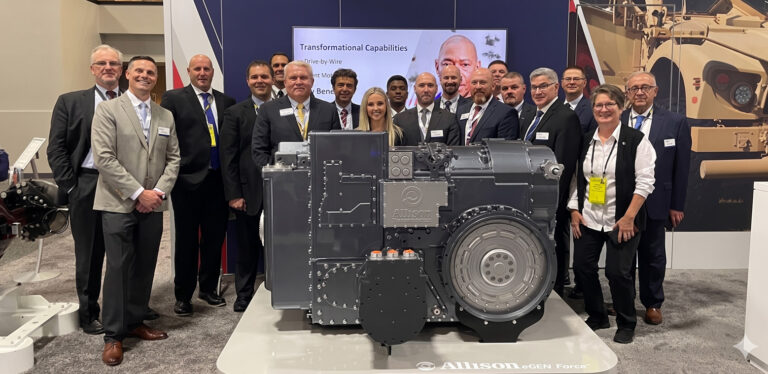
A visitor knows they are holding a model, and a print will not survive handling the way a machined casting does. For a sales call, a road show, a dealer program that needs twenty copies, or a launch that is ahead of production, none of that matters. The Allison eGen Force display we printed and finished is the kind of piece that carries a booth on its own.
Augmented reality
AR is content, not an object. A visitor points a tablet, or wears a headset, at the display in front of them, and a 3D model built from the CAD overlays it: the crank turns on a static cutaway, coolant flows through the block, the exploded view lifts away, a service step highlights the part it refers to. The same content runs on a print, on a static cutaway, on a production engine in a customer’s shop, or on a training bench a thousand miles from the show.
That is its strength: depth without freight, and updates without a rebuild.
When engineering changes the part, the content changes and every device gets it. When the show is in three countries, the content travels as a file. When the display is a static cutaway that could not be motorized, AR motorizes it.
Its weakness is the moment before the visitor stops. AR doesn’t pull anyone in from the aisle; a tablet on a stand is just one more screen. It needs a staffer to hand over the device and start the experience, and it needs a physical thing to point at. On its own, it is a demonstration. On top of a cutaway or a print, it is the second half of the conversation the physical display started. Our AR maintenance training post covers the training side of the same content.
How to decide
Answer these in order. The first one that gives a clear answer usually settles it.
- Does the product exist in production form? If not, it is a print or AR. A cutaway needs a donor unit.
- Is this an anchor show or a tour? One or two major shows a year, with a booth built around a hero piece: cutaway. A road show, a dealer circuit, or a sales team that flies: print, with AR for depth.
- What has to be proven? The quality of the real thing: cutaway. Scale, form, and configuration options: print. How it works, what flows where, what the service procedure is: AR or animation, on top of either.
- What is the drayage and freight budget? If the display has to be light, it is a print. If the display can be heavy, the cutaway earns its weight.
- How often does the product change? Annual updates: AR and prints absorb them cheaply. A stable platform: a cutaway will still be current in five years.
- Who staffs the booth? A thin crew needs a display that explains itself: cutaway or print. A trained crew can run AR all day.
- What is the lead time? Under eight weeks to the show: print or AR. Twelve weeks or more: any of the three.
Use them together
The booth that works hardest is usually three things from one model:
- A motorized cutaway as the anchor, placed where the aisle can see it move.
- 3D-printed models of the product family, or of the components too small or too internal to read on the cutaway, on the counter where visitors can pick them up.
- AR on a tablet that overlays flow, exploded views, and service steps on the cutaway and the prints, with the matching animation on the booth screen.
All three come from the same prepared CAD. The model cleaned up for the animation is the same model that gets printed and drives the AR. The cutaway is planned from the same data. That is the argument for one shop: not that any one display is better, but that the set is cheaper and more consistent when nobody has to rebuild the model three times.
What we need from you
For a print or AR: CAD, brand standards, and what the display has to make clear. For a cutaway: those plus a donor unit and the show date. For all three: where the display will go after the show, because that answer changes the crate, the case, and the content.
Send us the product, the show, and the date, and we will tell you which of the three fits, or which two.
FAQ
Which trade show display draws the most traffic?
A motorized, lit physical cutaway. Moving iron pulls engineers and executives in from the aisle in a way screens and models do not. A small-scale 3D print draws well once visitors are close enough to pick it up. AR is the follow-up, not the stop.
Which is the least expensive?
AR, once the 3D content exists, because it costs nothing to ship or duplicate. A 3D-printed model is next, and it scales well when you need several copies. A physical cutaway is the largest investment and also the longest-lived.
Which is fastest to produce?
A 3D-printed model or AR content, in days to a few weeks once the CAD is prepared. A physical cutaway typically takes eight to twelve weeks.
centers, the lobby). Spread across every venue, a well-built display is among the least expensive marketing a brand owns.
Can AR replace a physical display?
Not for the stop. AR does not draw a visitor in from the aisle, and it needs a staffer and a device. It replaces or adds depth, motion, and updates, turning a static display into a moving one. Most programs pair it with a cutaway or a print.
Can a 3D-printed model show the inside of a product?
Yes. A model can be printed sectioned, or with a translucent housing over a fully detailed interior. It reads as a cutaway without sectioning production hardware, which is the right approach for pre-production products or for a product family shown at one scale.
Can we fly with the display instead of shipping it?
A 3D-printed model in a foam-lined case usually can, and at many shows it can be hand-carried in without material handling charges, within the show’s rules—a physical cutaway ships as crated freight.
What if the product changes after the display is built?
AR content is edited; a print is reprinted with the changed parts; a cutaway is refinished or updated. All three cost far less than starting over, which is why the display should be designed with the next product revision in mind.
ABOUT TECHCOM
The company’s mission is simple: solve problems. We take our clients’ problems and make them our own. For more than fifteen years, we’ve enhanced marketing materials for Cummins, leveraging CAD data to deliver photorealistic renders of everything from complete systems to individual components.
Be sure to follow us for updates on social media on Facebook, Twitter, and LinkedIn.
Keep Reading
Related stories.
 INSIGHTS
What “WOSB” and “DoD-Ready” Actually Means for Your Program
What "WOSB" and "DoD-Ready" Actually Mean for Your Program "WOSB" means TECHCOM is certified by the U.S. Small Business Administration as a…
Read more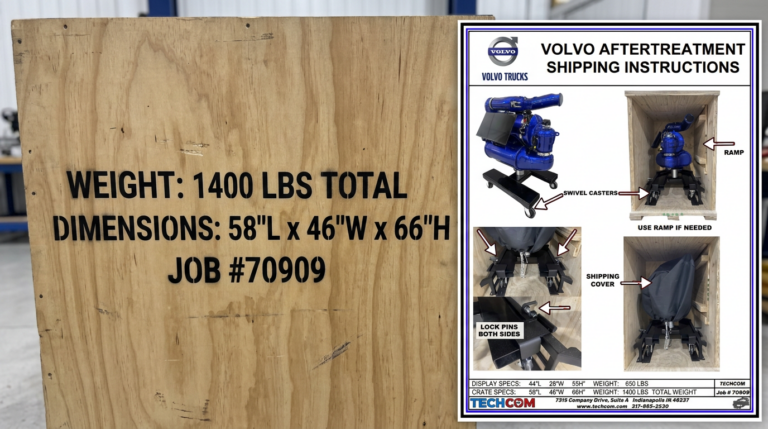 INSIGHTS
Crating a Two-Ton Engine Display for Trade Shows
How to Crate a Two-Ton Engine Display So It Arrives Show-Ready Choosing between real equipment and a lightweight replica for a trade…
Read more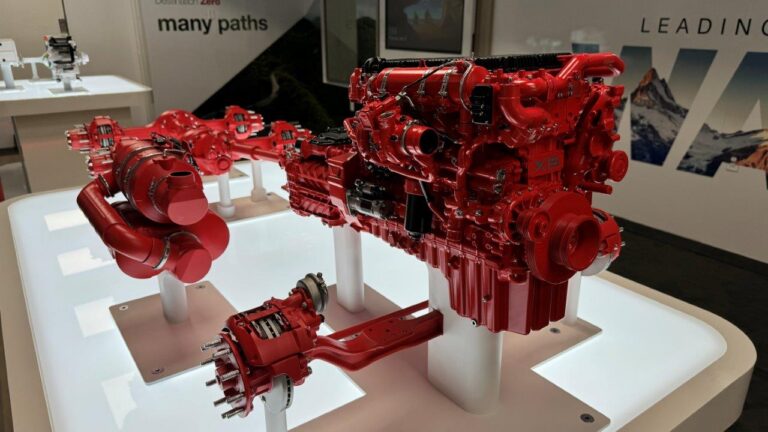 3D Printing
 Trade Show Presentations
Closing Deals with Tangible Hardware Most trade show floors are a sea of flat screens and generic banners. When you hand a…
Read more